
The Future of the US Dollar
Every few years, someone declares the dollar is finished. Debt is too high, and the deficits are unsustainable, China is rising, etc. I've heard some version of this for the past decade, and I want to walk through what the data shows, because I think a lot of clients are genuinely worried right now about the future of the US dollar and their investments.
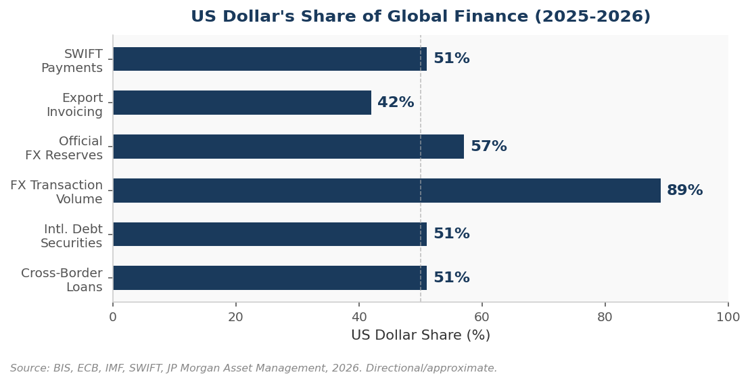
A new report from J.P. Morgan's Michael Cembalest tracked six separate measures of the dollar's role in global finance. Across all six, the numbers are largely stable. SWIFT payments (international money transfers) in US dollars actually rose to 51% in 2026, up from 39% in 2020. The dollar's share of FX reserves (assets held by foreign governments) did go down about 3% since 2020, but the gains went almost entirely to smaller currencies like the Singapore Dollar and the Korean Won, not to the Euro, the Yen, or the Chinese Yuan.
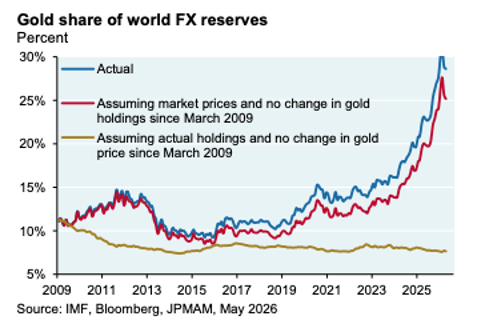
The gold story is worth addressing directly because people have been sounding the alarm that central bank gold holdings have risen as a share of global reserves from about 11% in 2009 to 29% today. If they are hoarding more gold, they must be buying less US debt. That sounds alarming until you look at why. In the report, they found that if you hold central bank gold allocations constant at their 2009 levels but use today's gold prices, the share is very high. But if you keep gold prices flat at 2009 levels and use actual holdings, the share falls to 8%. The increase is almost entirely a gold price story, not a shift away from dollars. For example, if you have a $1mm nest egg and a $1mm home, and your nest egg grows to $2mm, your net worth allocation has shifted from 50% investments, 50% real estate to 67% investments, 33% real estate. You aren’t making a deliberate shift away from real estate. Your other investments have just gone up in value.
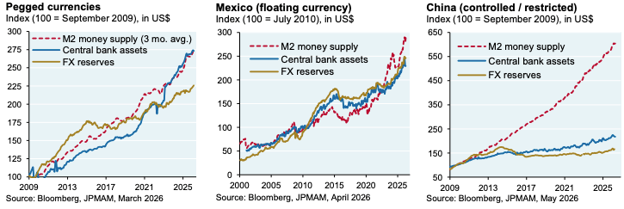
Now, what about China? The argument is that China is the world's largest economy, so shouldn't the yuan eventually replace the dollar? The report puts this plainly that 'China as world reserve currency is a frankly preposterous idea right now.' China's domestic banking system has ballooned to $60 trillion. However, their share of global assets is comparatively small (see the chart on the far right below). In plain English, there’s a lot of Yuan but very little Yuan actually outside of China. Because of this, if the Yuan became a global currency, the likely result would be massive outflows that crush their economy. So, they keep capital controls tight: a $50,000 annual cap on personal transfers out of the country, strict oversight of corporate transfers, and crackdowns on illegal cross-border trading. A currency under those conditions simply cannot serve as the world's reserve currency.
One legitimate long-term risk to the US dollar is the debt, which has climbed from 60% to 125% of GDP in twenty years, and the federal deficit is running wide. There are also real questions about predictability in the rule of law, which matters to foreign investors.
But predicting the dollar's demise has been a losing bet for decades. That does not mean nothing can go wrong. It means that the bar for a genuine reserve-currency transition is historically very high, the alternatives are weaker than the headlines suggest, and staying invested in US assets while the noise is loudest has generally been the right call.
Happy Planning,
Alex
This blog post is not advice. Please read disclaimers.