Where Is All The AI Spending Going?
Recently, I was meeting with a client who asked how sustainable the growth of the market is, and also about the earnings growth of these companies. The largest companies in the market (often referred to as the hyperscalers) are spending an enormous amount building out AI infrastructure. Investors rightfully want to know if these investments are well-spent money. Apollo published a chart recently that gets at this subject better than anything else I've seen.
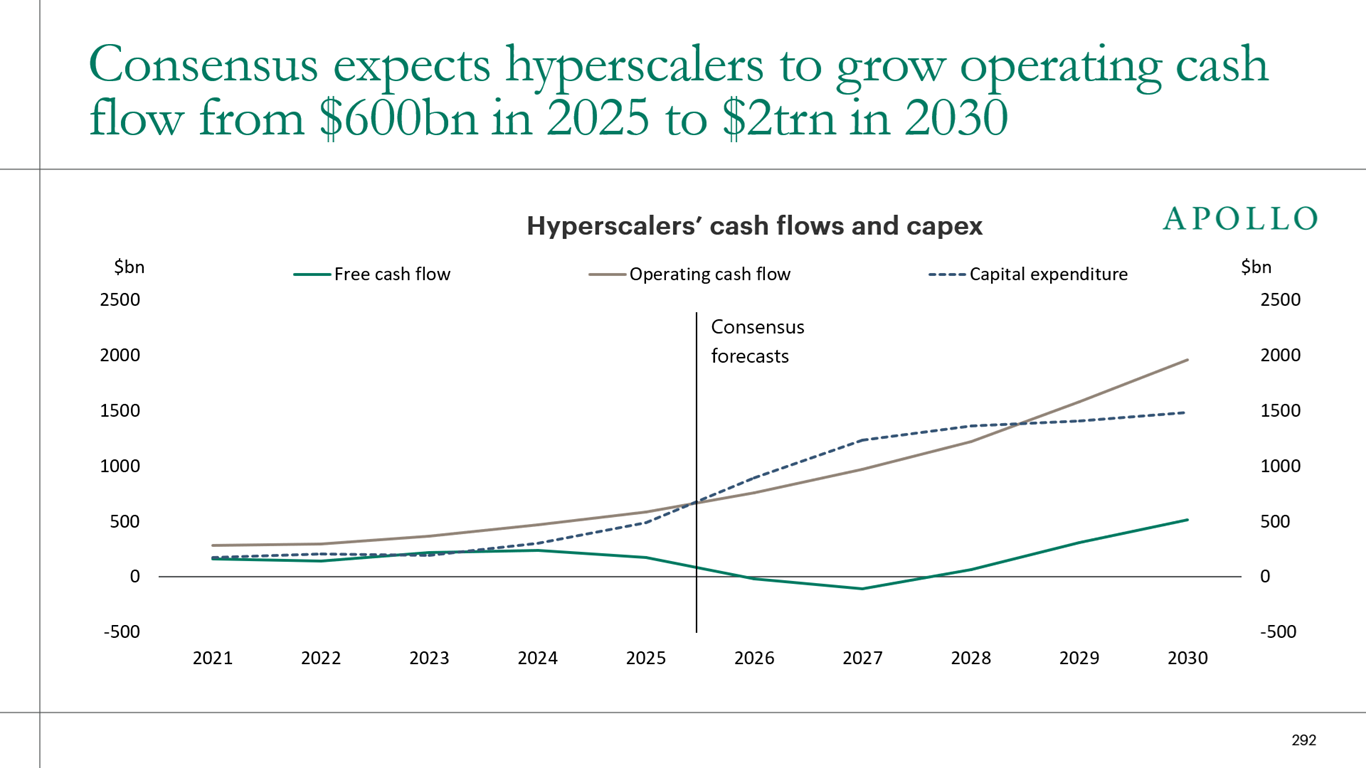
The chart tracks the hyperscalers’ operating cash flow, which is the actual cash the business throws off before big investments. It was at $600 billion in 2025, and consensus expects that to reach roughly $2 trillion by 2030.
Source: Apollo Global Management, company reports and consensus estimates.
Capital expenditures (the dashed line) is climbing right alongside it. Earnings at these companies have grown enormously over the past few years, but nearly all of that money is going straight back out the door into data centers, chips, and power contracts. Free cash flow, the money left over after these investments, dips to roughly zero in 2026 and goes slightly negative in 2027 before recovering.
A company spending every dollar it earns, plus some borrowed dollars, is making a bet that the spending produces more earnings later. However, if operating cash flow does not triple (from $600B in 2025 to $2T by 2030), it’s likely that capex plans get cut, and US GDP growth slows, because data center construction has become a real component of economic growth. That is probably the greatest risk in the market over the next few years.
However, it’s certainly possible that these investments will pay off. These companies are run by some of the brightest thought leaders in the world, and they wouldn’t spend so much if they didn’t expect it to pay off. Here’s an example of how it might pay off for one of the world’s largest companies, Google (not a recommendation to buy or sell). Google sells advertisements to companies wanting to sell products or services. If Google can produce better AI models through all this spending, they can run better ad targeting, and advertisers will pay more.
For example, if you are a local ice cream shop in Reston, VA, you might be okay advertising to anyone 18 and older living in Reston, VA. This might include people who don’t eat sweets or never go out for ice cream. However, if Google has more data and can offer you the ability to advertise just to people who go out for ice cream, that ice cream store will pay Google more.
I'm not making a call on whether the forecast lands. The reality is that most of long-term investing is seeing whether future expectations come to fruition. They often do, but sometimes don’t. When they don’t, it can get ugly for a while. That is why owning a diversified portfolio matters. If it doesn’t pay off, you should have a place to draw from that isn’t exposed to market volatility.
Happy Planning,
Alex
This blog post is not advice. Please read disclaimers.