How Do You Hedge AI Bubble Risk?
Two clients asked me a version of the same question over the past few weeks, so I wanted to share our conversation with you all. Two weeks ago, the 10-year Treasury reached a multi-decade high of over 5.3%, then reversed and finished the week at 5.1%. What turned it around had nothing to do with inflation. Yields fell because of concerns about whether there will be enough revenue from the AI buildout to justify the spend. As this happened, long-term Treasuries had their best week in over a year. That week was a small preview of how hedging risk works.
A big reason long rates are so high is the borrowing behind the AI buildout. If demand for bonds is limited, yields have to rise as supply increases for demand to follow. While nothing is guaranteed, it’s reasonable to think that if the AI trade breaks, growth expectations will come down, the Fed gets room to cut, and yields fall.
A good hedge might be to own assets that benefit when rates fall: bonds, value stocks, international, real estate, among others.
The last time a tech bubble deflated
From the start of 2000 through the end of 2002, the 10-year Treasury yield fell from roughly 6.5% to 3.8%, and large-cap growth stocks lost 55%.
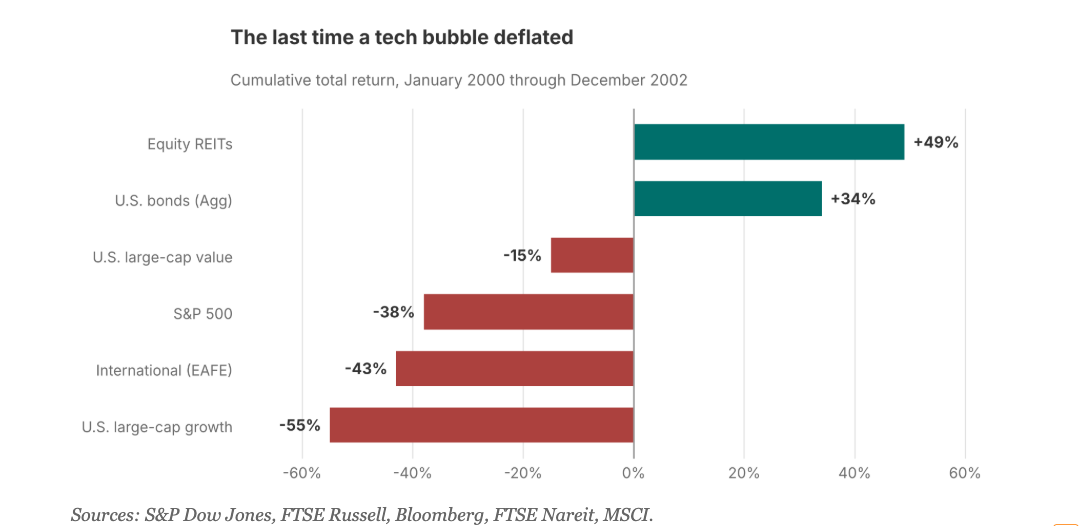
Over those same three years, the Bloomberg Aggregate returned 34% and equity REITs returned 49%. Value stocks and international, while still losing money, held up better than growth stocks. International stocks also beat the S&P 500 every calendar year from 2002 through 2007 following the decline.
Falling rates do not guarantee any of this works. In 2008, the 10-year went from about 4% to 2.2%, and the only thing on the list that really paid off was high-quality bonds.
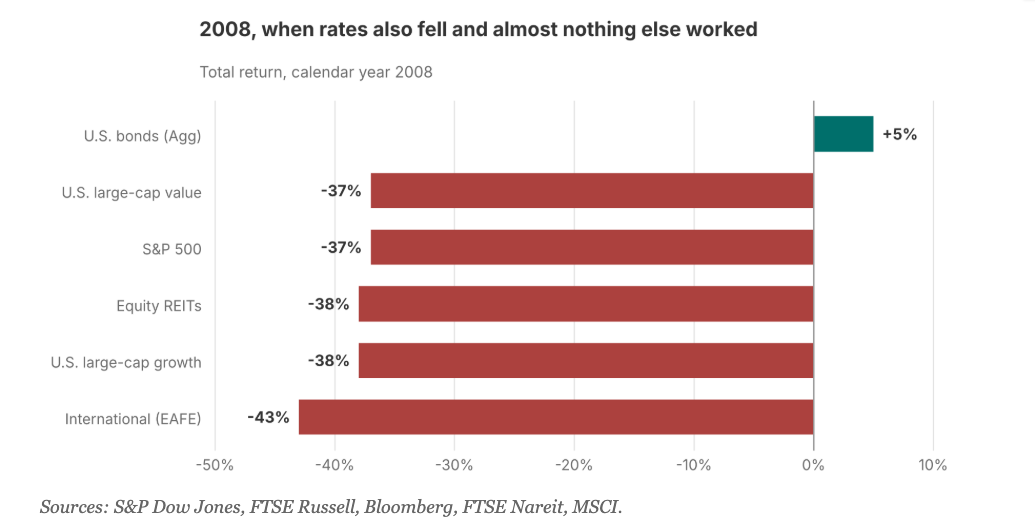
Value, REITs, and international all fell as hard as the index, because 2008 was a credit crisis and those are the assets most exposed to credit.
The distinction worth holding onto is which kind of unwind you get. An AI correction that is mostly an equity repricing probably looks like 2000 through 2002, and diversification does its job. I think an AI correction that takes the credit market down with it, with genuine leverage in this buildout, looks more like 2008, when high-quality bonds were the only shelter.
I’m not suggesting selling all the AI exposure. I’ve seen scenarios where revenue follows the buildout in the years to come, and all this spending looks completely justified. This is mostly about rebalancing rather than complete repositioning. A portfolio that has not been touched in a few years is carrying far more U.S. large-cap growth than its targets call for, and trimming that back into bonds and the lagging equity sleeves is the hedge.
Happy Planning,
Alex
This blog post is not advice. Please read disclaimers.