
The stock market is sitting near all-time highs again, and a small group of names has done most of the lifting. When that happens, it’s natural to wonder whether it's better to buy a handful of those stocks instead of the whole index.
One of the biggest advantages of owning an index is behavioral. An index hides a lot of pain. Through October 30 of this year, 66 percent of S&P 500 stocks had already fallen 20 percent or more at some point in 2026 (Source: The Compound Media, data via Bloomberg Finance L.P.). That is two out of every three companies inside an index that is having a perfectly good year.
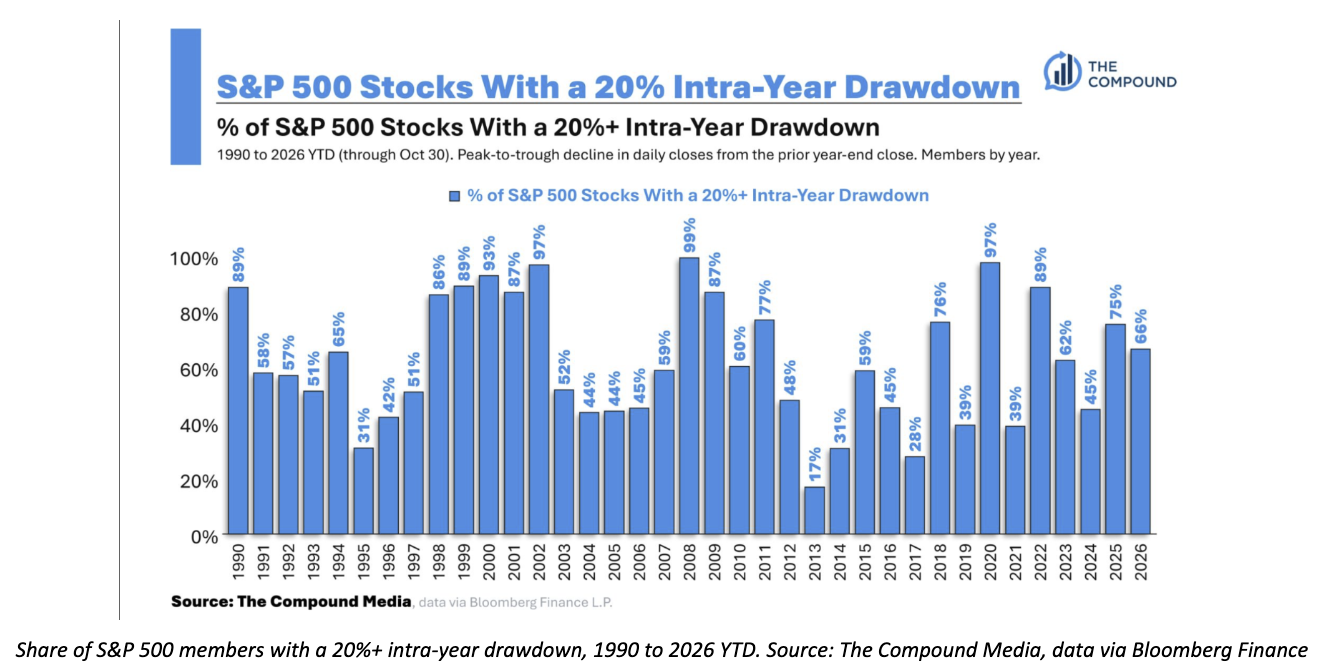
Going back to 1990, a typical year sees about 60 percent of index members take a 20 percent hit, and in four of those years it ran above 90 percent. The index absorbs it all because the names that are down are offset by the names that are up, and you never have to watch any of it happen.
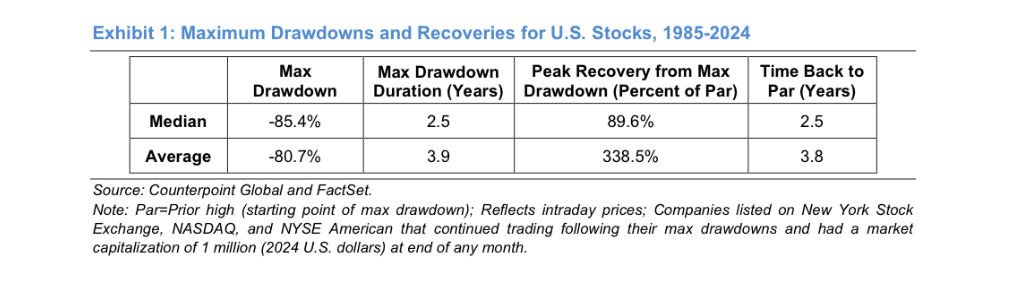
Over a full lifetime, the numbers get harsher. Counterpoint Global studied more than 6,500 U.S. stocks from 1985 through 2024 and found the median maximum drawdown for an individual stock was 85.4 percent, and that about 54 percent of those stocks never made it back to their prior high (Source: Mauboussin and Callahan, “Drawdowns and Recoveries,” Counterpoint Global, 2025). The S&P 500 itself fell by a maximum of 58 percent over that same stretch, and it recovered.
You would hope all that extra volatility buys you something. Mostly, it does not. Hendrik Bessembinder's study of every U.S. common stock from 1926 to 2015 found the median lifetime return was negative 3.7 percent, and that fewer than 4 percent of stocks produced all of the net wealth the market created. The market's long-run return is real, it just comes from a short list of names that most won’t be able to pick out in advance.
But let’s say you do own one of them. Amazon lost 94 percent of its value between December 1999 and October 2001. Someone who bought at the top and held the whole way through has done extraordinarily well, and almost nobody did, because sitting on a position that is down 94 percent takes a conviction most people find out they do not have somewhere around the 50 percent mark. A 20 percent decline in a diversified portfolio feels like the market doing what markets do. The same decline in a stock you picked yourself feels like something you got wrong, and that's much harder to sit through.
None of this makes individual stocks off limits. Plenty of our clients hold company stock, or a long-held position, or a small play account. But making individual stock selection a large part of your long-term investment plan is a very difficult thing to pull off.
Happy Planning,
Alex
This blog post is not advice. Please read disclaimers.