
Market Leadership Changing Hands
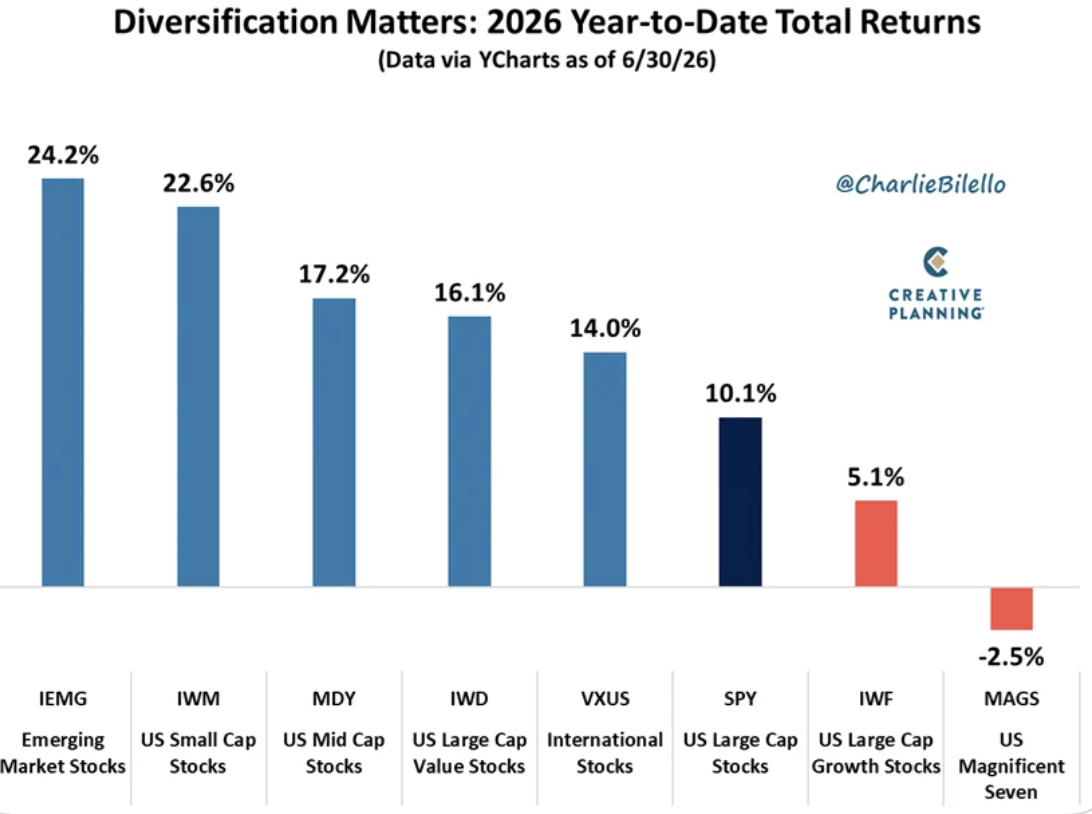
For the last couple of years, a small handful of companies have done most of the heavy lifting in the stock market. The hyperscalers (Microsoft, Amazon, Google, etc.), the massive cloud and software companies that have been pouring money into AI infrastructure, pushed the market forward. Recently, there has been a shift in market leadership, with strong returns coming from value stocks, particularly the semiconductor stocks that actually make the physical chips powering all the AI investments. Emerging markets are the best-performing asset class heading into the 2nd half of 2026, largely due to one country (South Korea) and just a handful of chip-making stocks there (SK Hynix and Samsung).
For years, hyperscalers generated the bulk of the free cash flow tied to the AI buildout. They were the ones spending on data centers, and their cash flow reflected the payoff of that spending. But the hyperscalers have begun investing nearly all of their profits (and then some) into buying memory chips that they believe will be a long-term payoff. As a result, free cash flows have shifted dramatically.
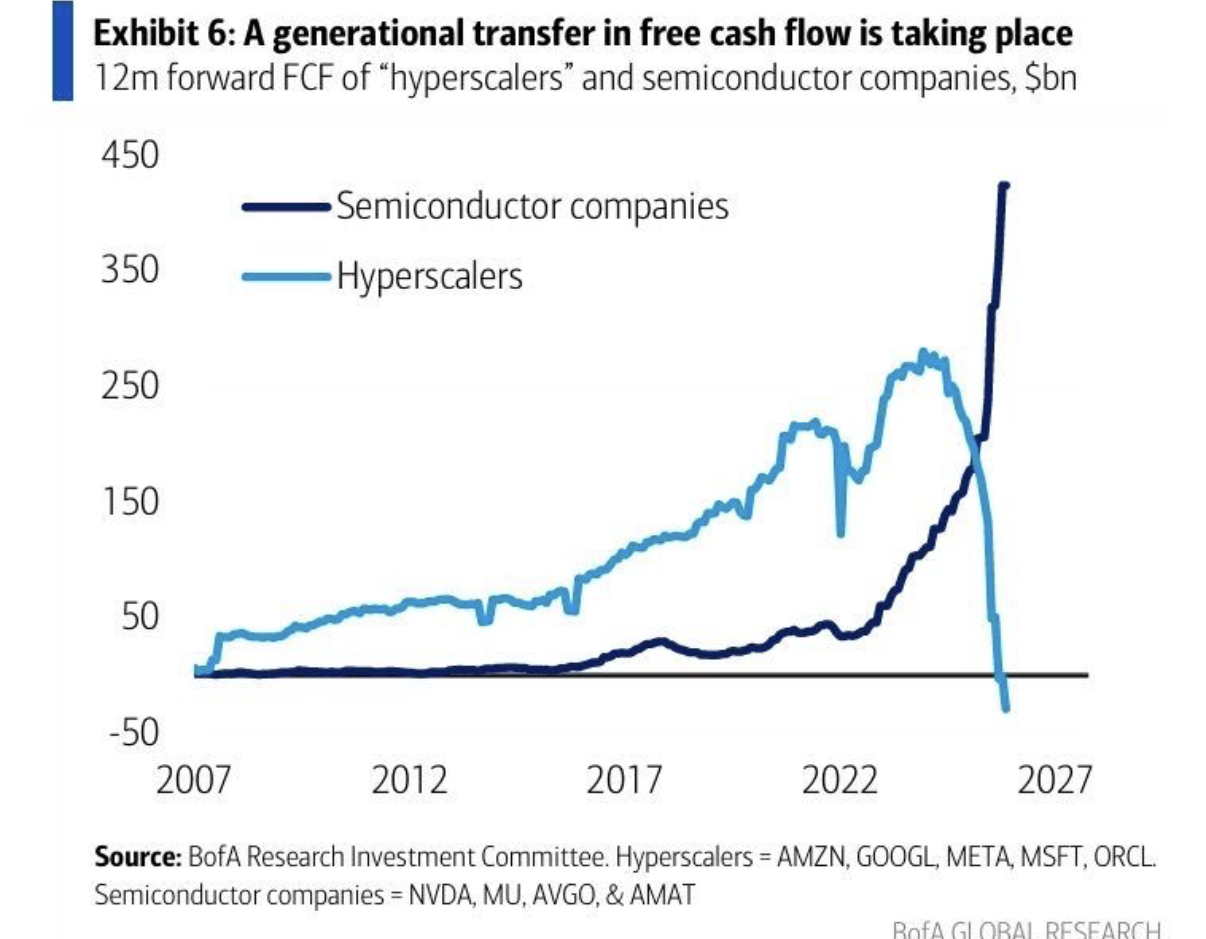
This matters to investors because it's a sign that the market is broadening out. When one small group of stocks drives all the returns, it can be fragile. It only takes one disappointing earnings call from one company to knock the whole market sideways. But when leadership starts to pass from one group to another, that's usually a sign of a maturing trend.
We're seeing a similar pattern outside of tech, too. Through the first half of this year, small-cap stocks, mid-cap stocks, international stocks, and emerging markets have all outpaced the handful of giant tech names that dominated headlines for the past few years. Nothing stays on top forever, and that's actually good news if you own a diversified portfolio instead of a concentrated bet on recent winners.
Right now, the benefits are shifting toward the chipmakers. But next year, it could be the companies building the power infrastructure to support all of this, or the software companies figuring out how to use it well. That's exactly why we don't try to pick the single winner. We own the whole basket and let the leadership rotate through it.
None of this means the ride will be smooth. Chip stocks are historically volatile, and a pullback in AI spending would hit them just as hard as it once helped them. But zoom out, and this handoff is a reminder that markets are bigger than any one company.
Happy Planning,
Alex
This blog post is not advice. Please read disclaimers.