Where Do Bonds Go From Here
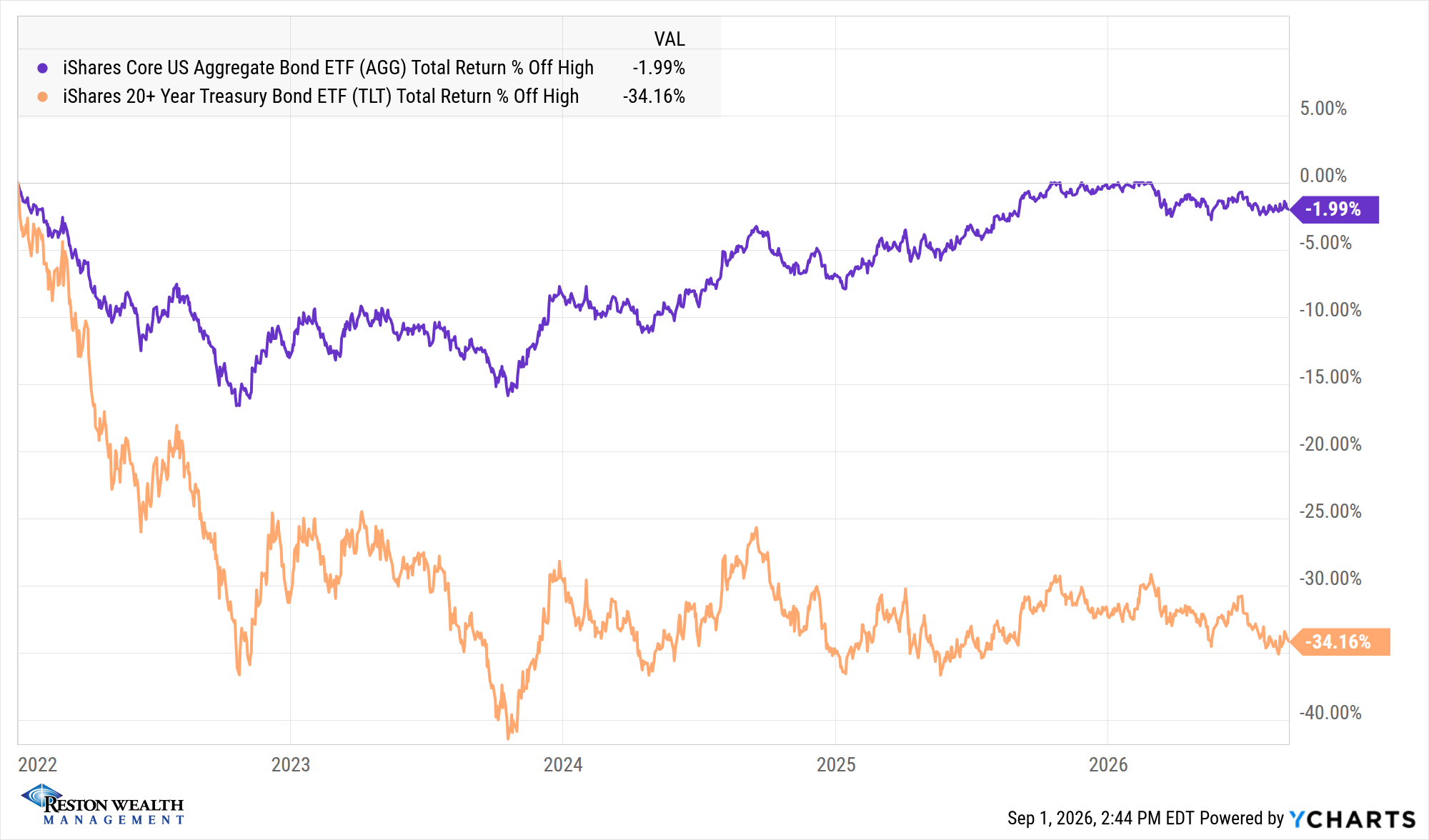
Nobody is excited to own bonds right now, and for good reason. Bonds are supposed to be the boring part of the portfolio and instead they have delivered the worst stretch in the history of the asset class. In fact, we were recently updating Investment Policy Statements for clients and had to put “N/A” for the “length of recovery” in the bond market benchmark because we are still technically in a drawdown from the 2022 selloff.
Before I dive into an update on the bond market, let we walk you through some of the basic mechanics. Bond prices and interest rates move in opposite directions. Say you buy a $1,000 bond that pays 4% a year for ten years. A month later the government starts issuing new ten-year bonds paying 5%. Your bond has not changed. It still pays you 4% a year exactly as promised. But nobody is going to hand you $1,000 for a bond paying 4% when they can hand the same $1,000 to the Treasury and get 5% now. So, if you want to sell, you have to discount the price until the buyer's math works out to 5%. That discount is the loss you see owning the bond.
The longer the bond, the bigger that discount has to be, because the buyer is stuck with your below-market coupon for longer. It is why a 30-year bond can drop 8% on a one-point move in rates while a 2-year barely budges. This is what happened over the past few years as the Fed raised rates to try to bring down inflation (if rates go and it costs more to borrow, people/businesses spend less, and inflation shrinks).
It works in reverse too. When rates fall, your above-market coupon becomes the valuable one, and the same math that punished you starts paying you. I think bonds have that potential in the current environment where everyone hates them.
Every reason to dislike bonds is public information. There is no secret bearish case on Treasuries that you and I have figured out. When information is that widely known, it is already in the price. The bear case is completely valid in my opinion. But I also think you're being paid enough to live that uncertainty.
The table below comes from F/m Investments. It shows what a Treasury would likely return over the next twelve months under different interest rate scenarios.
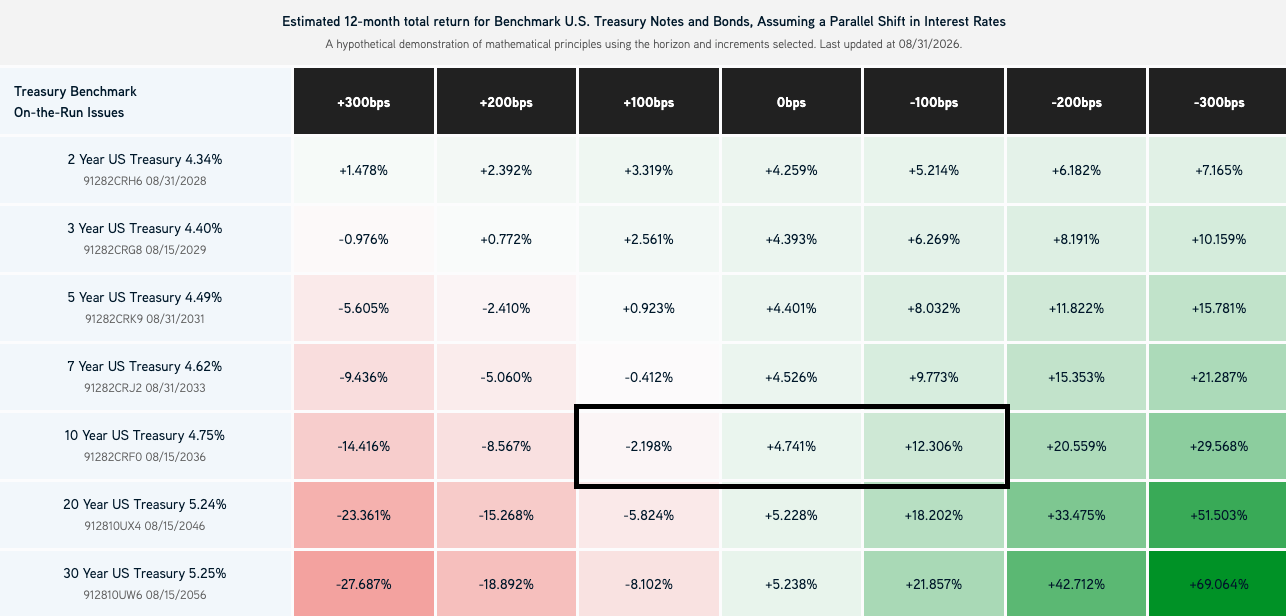
Source: U.S. Department of the Treasury data and calculations as of 08/31/2026. The table above shows the estimated 12-month total return from interest and price change of on-the-run, benchmark U.S. Treasury Notes and Bonds for a given move in yields. Yield changes are assumed to be parallel across the curve and are based on duration and yield as of 08/31/2026. This analysis is for illustrative purposes only and is not indicative of future returns.
The scenario above is hypothetical in nature and is designed to show the cumulative change in return in the most recently issued U.S. Treasury bonds or notes of a particular maturity for a given increase or decrease in interest rates over equal 12-month periods. The following scenario analysis is not representative of any of the US Benchmark Series ETF's, is designed for informational purposes, and is not an offer to buy or sell any security. The information utilized has been provided by third party vendors which are believed to be accurate at the time of use. Although taken from reliable sources, FM cannot guarantee the accuracy of information received from third parties. The information is current as of the date of this presentation and is subject to change at any time, based on market or other conditions. All investing involves risk, including the possibility of loss of original investment. You should consider the investment objectives, risks, and fees before investing. Treasury securities and the associated coupon payments are not guaranteed and are solely based on the creditworthiness of the United States Government.
Let’s look at the middle section that I boxed off, which shows a hypothetical return for 10-year treasuries if interest rates are flat, down 1%, or up 1%. If rates go absolutely nowhere for a year, the estimated return is 4.7%. Now, if rates rise 1%, returns are potentially down 2+%. However, if rates fall a single percentage point, the 10-year potentially returns 12.3%. That is much more upside than downside.
I am not predicting that rates will fall. I do not know, and neither does anyone quoting a year-end target on television. But I do know rates are higher now so for the first time in a very long while, you are getting paid to wait and find out.
Happy Planning,
Alex
This blog post is not advice. Please read disclaimers.