
Direct Indexing Explained
While most investors focus on their gross return (the number on your statement or custodial website), the most important number is your net after-tax return. If two investments earn the same rate of return but one is taxed at a higher rate, we know who is coming out ahead. For the right client, direct indexing can significantly improve after-tax returns.
Before you continue reading, this strategy is mostly used in taxable brokerage accounts, so if the bulk of your money sits in an IRA or a 401k, this post is more informational than anything else.
Typically, when you buy an index fund, you own one investment, and inside it are several hundred companies. Direct indexing gives you those same companies, except you own the shares themselves, weighted so the whole thing behaves like the index. On your statement, you will see each stock you own (i.e Apple, McDonalds, etc).
In a year when the index finishes up ten percent, it is normal for a third of the companies inside it to be down, which is just how averages work. If you own the fund, you never see any of the companies at a loss. When you own the pieces, every holding has its own cost basis. Direct indexing scans the account, sells the positions trading below their cost basis, and immediately buys something similar so your market exposure doesn’t change.
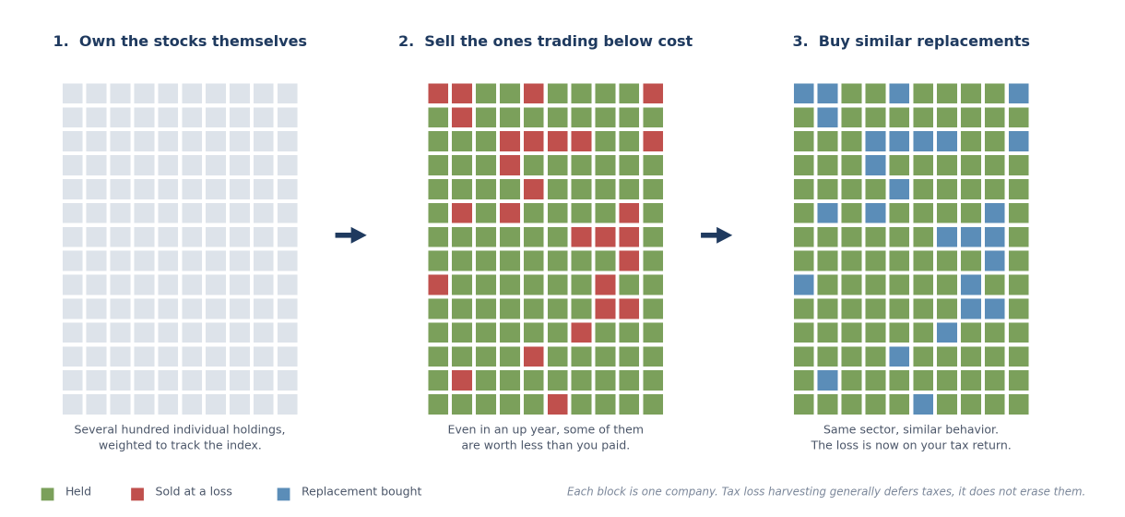
The losses offset capital gains on your return, and if you run out of gains, you can deduct up to $3,000 of ordinary income per year, with the rest carrying forward (Source: IRS Topic No. 409). The replacement must be a similar stock rather than the same stock, because repurchasing within 30 days on either side triggers the wash sale rule and disallows the loss (Source: IRS Publication 550).
This strategy defers taxes, it does not erase them. Your replacement shares carry a lower cost basis, which likely means a larger gain someday. You have moved the tax bill into the future and put the tax savings today to work in the meantime.
I use this strategy for many clients with taxable accounts that are in high tax brackets. But because you are punting the taxes down the road, not avoiding them altogether, there are two common use cases that really benefit from direct indexing.
Charitable Giving
If you already give to a church, a university, or a donor-advised fund and write a check, you are likely leaving money on the table. You can gift the appreciated shares instead, then use the cash you would have donated to buy those same shares back. The charity gets the same amount, you avoid capital gains tax, and your new shares have a higher basis. The wash sale rule isn't a problem here, since it applies only to losses.
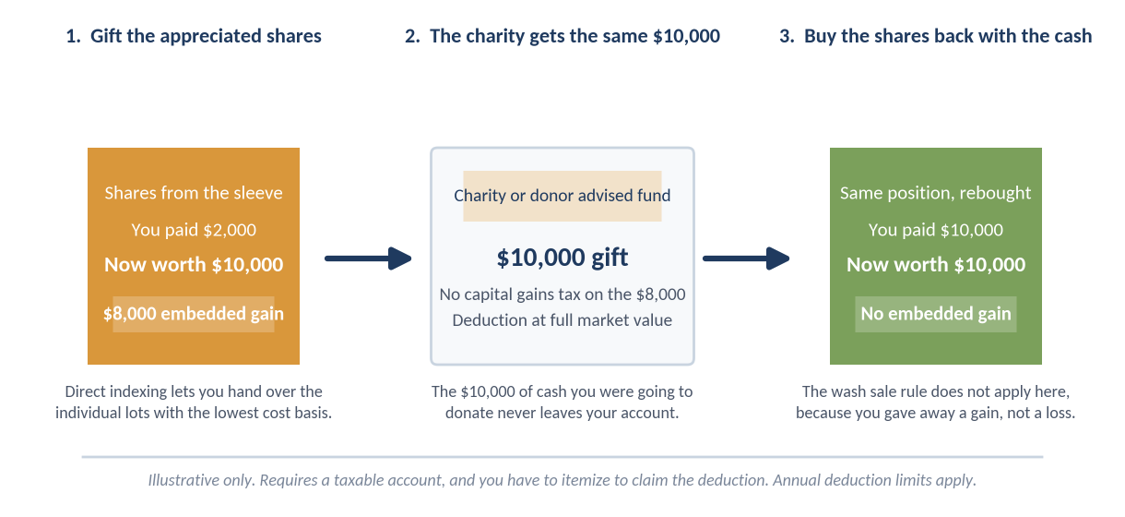
One last note on this - you must hold the stock for more than one year to fully deduct its fair market value when you donate it to charity.
Concentrated Stock
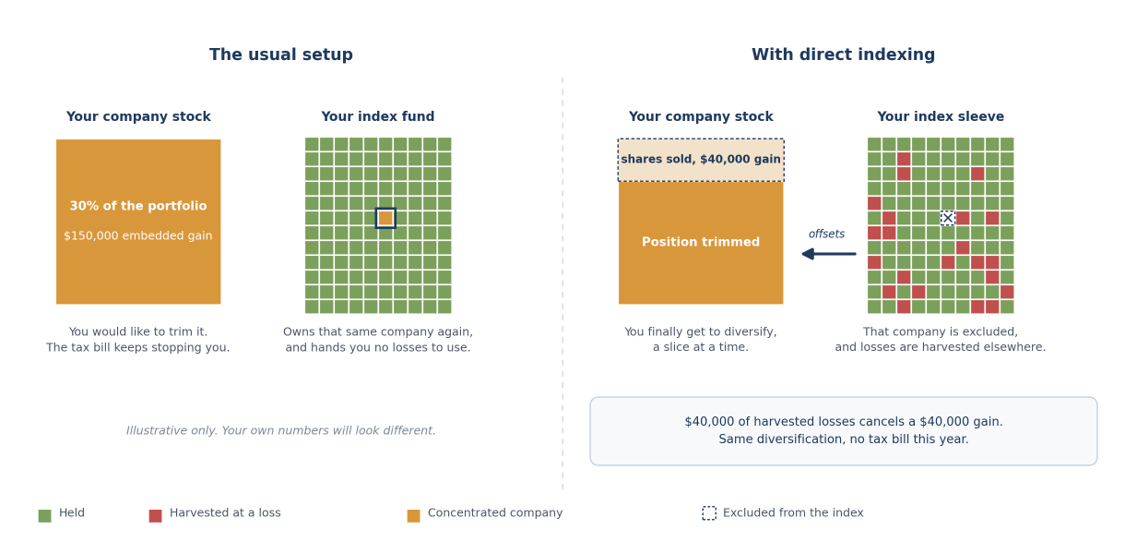
The second case is for someone sitting on a very large position with embedded gains. Often this is somebody who spent a career at one company receiving stock options, or they made a great stock pick a few decades ago.
Direct indexing helps here first by excluding. Because you own the individual stocks, you can leave that company out of the sleeve and underweight its sector, which matters since a standard index fund is quietly buying you more of the company you are already overweight. The second is the losses this strategy can throw off every year, so you sell a slice of the concentrated position and cancel the gain with those losses, then do it again the following year. Unwinding the position that way is usually a multi-year project, depending on the size of the stock and the amount of their other investments available.
A few warnings before putting something like this in place. First, it is more expensive than an ETF, though far less than it used to. Also, most providers want a minimum, often a few hundred thousand dollars. Harvesting opportunities also shrink as the portfolio appreciates. Lastly, wash sales can be triggered by the same stocks in your spouse’s account or your 401k, so you have to monitor all your accounts to put this in place effectively.
A strategy isn't better just because it is more complicated, and for plenty of families, a low-cost index fund and a disciplined plan is enough. But for investors in high tax brackets, with concentrated stock, or who are charitably inclined (or, best of all, all three), this strategy can make a big difference.
Happy Planning,
Alex
This blog post is not advice. Please read disclaimers.